



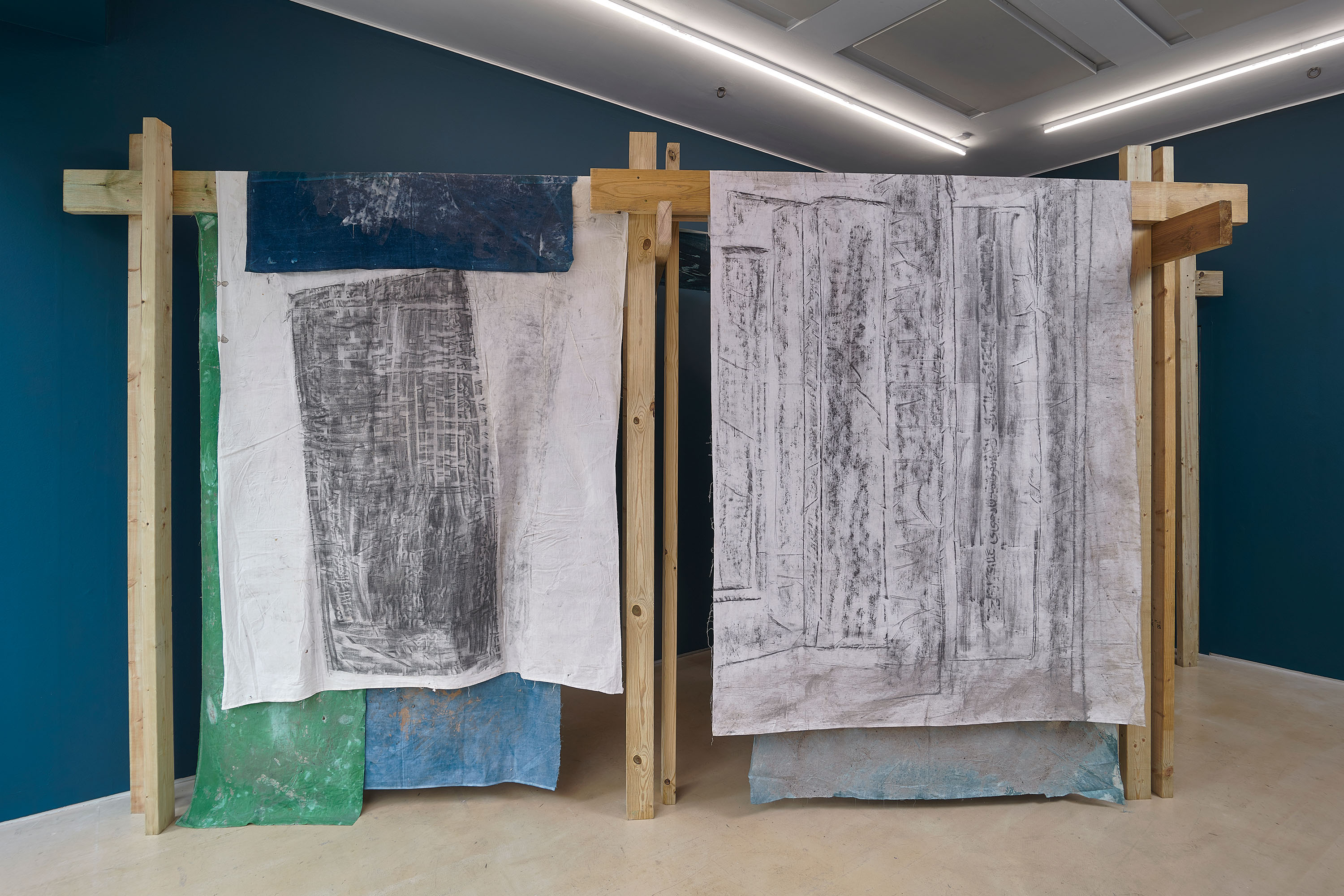
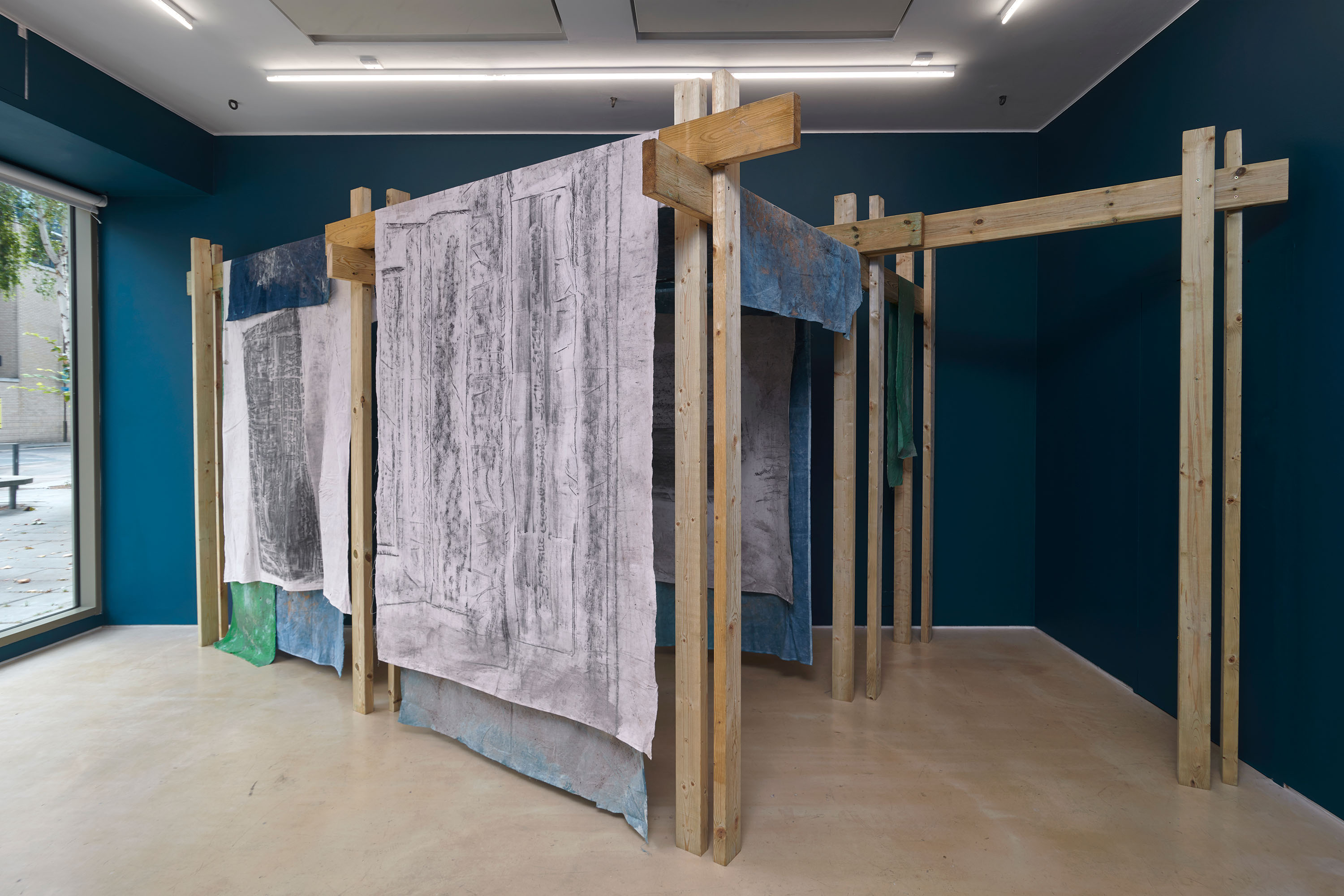


Cemetery of Martyrs is a major new co-commission by Beirut and London-based artist Dala Nasser, produced in collaboration with Nottingham Contemporary and KM21, The Hague, Netherlands. Nasser’s new body of work comprises a canopy of dyed and marked fabrics, layered and draped over a site-specific wooden structure and an accompanying text work.
Nasser’s work explores history, displacement and community through a relationship with abstraction and alternative forms of image-making. She integrates sound, performance and film in her work, but remains quintessentially a painter, working with the medium’s most elementary materials: fabric, pigments, stretcher bars and mark making.
Cemetery of Martyrs departs from Nasser’s past works that explore the cultural and political histories of Southern Lebanon and wider West Asia; a region imprinted with the remnants of ancient societies, landscapes and geology. Whereas Nasser’s previous work has drawn on historic subjects and sites, ranging from the tragic love story of mortal Adonis and goddess Aphrodite, the 600-400 BCE tomb of King Hiram, or most recently, three tombs of Noah in Lebanon, Turkey and Jordan, her new commission transforms Peer’s exhibition space into a symbolic graveyard.
This new body of work is the outcome of many years of research and field trips, guided by conversations with historians, her communities and collaborators. Using the process of frottage (the technique of taking a rubbing from an uneven surface), Nasser worked in many geographic contexts to collect charcoal grave rubbings from the gravestones and sites of seminal artists and intellectuals from Lebanon, Palestine, Syria, Egypt, Jordan, the United Kingdom and the United States, who all, at some stage of their lives, spent time in Beirut, Lebanon. Included in the work are Etel Adnan, Inji Aflatoun (also Efflatoun), Mahdi Amel, Ghassan Kanafani, Khalil Sakakini, Raif Khoury, Laila Shawa and Anbara Salam Khalidi, amongst many others.
The resulting collection of graves represents the lives of cultural figures from the mid-nineteenth century (specifically The Nahda, a cultural and intellectual Arab Renaissance movement) to the present day, who all used their art as a tool to fight for independence and freedom in times of political dominance and occupation. Each life represented in the installation has, through their own artistic and intellectual work, shaped the notion of true sovereignty in Western Asia.
Within the installation, Nasser layers cyan blue and charcoal-marked sheets of cloth amongst black and green mourning fabrics that she has dyed and marked with shells, seeds, ash, and crushed malachite. The charcoal rubbings transcribe the surfaces of known graves, while the cyanotype treated fabrics act as a visual representation of those whose graves are unreachable or unknown by featuring the person’s name transcribed in Arabic using various scales and legibility. A document accompanies the exhibition, offering an individual obituary for each of the artists, writers, poets, filmmakers, historians, journalists, and others included in the cemetery. Written by Nasser in collaboration with translator and researcher Rayyan Abdelkhalek, the booklet acts as a way of commemorating each life and legacy beyond the physical cemetery.
Cemetery of Martyrs initiates a reflection on the challenge of interpreting the extreme and unceasing violence of the present moment, and invites audiences to reckon with their own role in forging new pathways of thought and action. Nasser’s cemetery creates a collective space to gather and reflect on the legacies of people who were steadfast in their commitment to freedom and cultural sovereignty; a graveyard to mourn, learn, and reaffirm the power of culture, art and humanity to connect us to histories of resistance and renewal.
Nasser’s exhibition is accompanied by a series of events as part of Peer’s Talks, Events and Workshops programme. Cemetery of Martyrs is part of Peer’s 2026 Programme, which examines themes including the construction of place, sovereignty and community and includes solo exhibitions by artists Leah Clements, Okiki Akinfe and a forthcoming 2027 commission by Ceidra Moon Murphy.
TALKS, EVENTS AND WORKSHOPS
East End Day: Curator's Tour
11 October 2026, 3-4pm
Coinciding with Frieze London and Frieze Masters 2026 East End Day, Peer hosted a curator’s tour of Dala Nasser’s exhibition with Beulah Ezeugo, Curator at Peer.
Artist Talk: Dala Nasser and Sohrab Mohebbi
16 October 2026, 11.30am-12.30pm
Artist Dala Nasser and Director of SculptureCenter, Sohrab Mohebbi, discussed Nasser’s painting practice and her new body of work, Cemetery of Martyrs.
Listening Event: Ahmad Kaabour
17 October 2026, 5-7pm
An intimate listening event and celebration of iconic singer-songwriter, Ahmad Kaabour (1955 - 2026) with his son, writer and visual artist, Marwan Kaabour.
Exhibition Response: Wassila Abboud - Mahdi Ahmel on Franz Fanon
4 November 2026, 7-9pm
In collaboration with Basecamp for Tactical Imaginaries in the Netherlands, cultural worker and writer, Wassila Abboud hosts a discussion with historian Ziad Kiblawi, centering the anti-colonial origins of Lebanese Marxist philosopher Mahdi Amel’s work.
Offsite Film Screening: One Hundred Faces for a Single Day (1972), directed by Christian Ghazi
26 November 2026, 8:30pm (Run time: 92')
Institute of Contemporary Arts, London SW1Y 5AH
In collaboration with the Institute of Contemporary Arts, Peer presents a public screening of One Hundred Faces for a Single Day (Mi'at Wajeh Li Yawm Wahed) (1972), Ghazi’s avant-garde experimental 16mm film, which critiques the behaviour of Beirut’s elites during Lebanon’s Golden Age, contrasting their apathy and comfort with the struggles of the working class.
Community Coffee Morning with Curator's Tour of Cemetery of Martyrs
10 December 2026, 9.30-10.30am
A community coffee morning at Peer with an introduction on Cemetery of Martyrs from Peer’s Director, Ellen Greig.
BIOGRAPHY
Dala Nasser (b. 1990, Tyre) lives and works in London and Beirut. Selected exhibitions include: Cemetery of Martyrs, KM21 The Hague, Netherlands and Nottingham Contemporary; Xíloma. MCCCLXXXVI, Kunsthalle Basel; Aichi Triennale 2025: A Time Between Ashes and Roses, Nagoya, Japan; Flesh Flowers, Aishti Foundation, Beirut, Lebanon (all 2025); Adonis River, Renaissance Society, Chicago, USA; Red in Tooth, Kölnischer Kunstverein, Cologne, Germany; Whitney Biennial 2024: Even Better Than the Real Thing, Whitney Museum of Art, New York; Diriyah Biennale 2024: After Rain, Riyadh, Saudi Arabia (all 2024); Time spent without its flow, V.O Curations, London and 58th Carnegie International, Carnegie Museum of Art, Pittsburgh (all 2022). She is the recipient of the forthcoming inaugural Frieze Abu Dhabi Artist Award 2026, curated by Nabila Abdel Nabi.
SUPPORTERS
Cemetery of Martyrs has been produced with support from the Henry Moore Foundation.
Cemetery of Martyrs at Peer is supported by Headline Supporters: Cockayne Grants for the Arts, Fahad Mayet and Lorenzo Leviste, and the Dala Nasser Supporters Circle: Yasmine Bassili and May Calil. With thanks to Commonwealth and Council.
Peer’s 2026 Programme is supported by the Paul and Louise Cooke Endowment.
Peer is an Arts Council England, National Portfolio Organisation and is supported by Hackney Council through a Voluntary Sector lease.
Peer Ambassadors 2026 is supported by Hackney Council Community Fund and NCEL Collaborative/Compass Wellbeing CIC. With thanks to Great Art.
Cemetery of Martyrs is produced and commissioned by Nottingham Contemporary in collaboration with KM21 The Hague, Netherlands and Peer, London.
PRESS
T – The New York Times Style Magazine: Middle East North Africa